
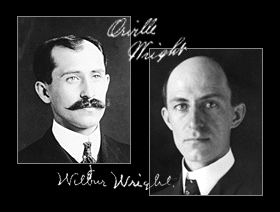
People had dreamed of flying for many years. The United States Army was trying to develop an airplane in 1903, but the plane wouldn't fly. The New York Times wrote that maybe in 1 million to 10 million years they might be able to make a plane that would fly. Only eight days later Wilbur Wright and his younger brother, Orville. were successful in flying the first manned plane airplane and it had stayed in the air for 12 seconds 120 feet (37 meters) ! The brothers made three more flights that day. The longest, by Wilbur, was 852 feet (260 meters) in 59 seconds. Only five people were there to see the flights, and very few newspapers even wrote a story about it.
The Wright brothers, Orville (August 19, 1871 – January 30, 1948) and Wilbur (April 16, 1867 – May 30, 1912), were two Americans credited with inventing and building the world's first successful airplane. The Wright house provided an excellent setting for the children's intellectual and creative development. Orville wrote of his childhood: "We were lucky enough to grow up in an environment where there was always much encouragement to children to pursue intellectual interests; to investigate whatever aroused curiosity."
Both brothers attended high school, but did not receive diplomas. The family's abrupt move in 1884 from Richmond, Indiana to Dayton (where the family had lived during the 1870s) prevented Wilbur from receiving his diploma after finishing four years of high school. They did not go to college, the brothers had intuitive technical ability. Before building their airplane, they had built a printing press and operated a bicycle repair and sales shop. They constructed their own bicycles. The profits from their bicycle business funded their airplane-building venture.
Idea's of Flying
In the late 1800s, the world’s leading scientists were trying to construct a machine that could soar above the earth. One by one these brilliant scientists failed, some even falling to their deaths, victims of their own winged contraptions. So, how could Orville and Wilbur even think of succeeding when no one else could?
But succeed they did. This is the story of their life, the risks they took, despite the multiple failures, and their unwillingness to accept defeat. This is the story of how the Wright Brothers find a way to change the world for the better.
In 1878 their father, who traveled often as a bishop in the Church of the United Brethren in Christ, brought home a toy "helicopter" for his two younger sons. The device was based on an invention of French aeronautical pioneer Alphonse Pénaud. Made of paper, bamboo and cork with a rubber band to twirl its rotor, it was about a foot long. Wilbur and Orville played with it until it broke, and then built their own. Orville and Wilbur Wright became convinced that the possibility of powered, sustained, controlled flight of an airplane was more than mere fantasy. By 1900 they had built a machine that they believed would fly. The brothers' first glider, tested in 1900, failed to fly. A second trial in 1901 fared better, but they went on the improve the design. Later that year, the brothers built a wind tunnel in which they tested over 200 wing and airframe designs. This resulted in a successful glider model.
Undeterred, a wind tunnel was built in order to work out the correct lift data required for such an aircraft. Whilst experimenting in the wind tunnel they discovered that longer, narrower wings were more effective. Combined with their earlier discovery concerning roll, pitch, and yaw, which effectively controlled the aircraft, they had arrived at a winning combination. On December 17, 1903 Orville took off in "The Flyer' and controlled it in the air for twelve seconds. Feverish alterations were made and by 1905, thirty-minute flights had been achieved. Twelve months later they had received their patent for the "˜Wright Flying Machine'.
The Wrights believed that airplanes would eventually be used to transport passengers and mail. When the Wrights first offered their machine to the U.S. government, they were not taken seriously, but by 1908 they closed a contract with the U.S. Department of War for the first military airplane.
Wilbur Wright
Neither brother married. Wilbur once quipped that he "did not have time for both a wife and an airplane." He became ill on a trip to Boston in April 1912. After returning to Dayton, he was diagnosed with typhoid fever. He lingered in and out of consciousness for several weeks until he died, at age 45, in the Wright family home on May 30. His father Milton wrote about Wilbur in his diary: "A short life, full of consequences. An unfailing intellect, imperturbable temper, great self-reliance and as great modesty, seeing the right clearly, pursuing it steadfastly, he lived and died."
Orville Wright
Orville succeeded to the presidency of the Wright company upon Wilbur's death. Orville made his last flight as a pilot in 1918 in a 1911 Model B. He retired from business and became an elder statesman of aviation, serving on various official boards and committees, including the National Advisory Committee for Aeronautics (NACA), predecessor agency to the National Aeronautics and Space Administration (NASA) and Aeronautical Chamber of Commerce (ACCA), predecessor to the Aerospace Industries Association (AIA). Orville was elected to the Hall of Fame for Great Americans in New York City in 1965.
Orville died on January 30, 1948 after his second heart attack, having lived from the horse-and-buggy age to the dawn of supersonic flight.


0 comments:
Post a Comment
If you like this post so please tell me Ill waiting for.......